Facilities, venues, internal use

Your building, running its own print program.

When one of the world's largest e-commerce and logistics operators needed internal wayfinding and compliance signage across its buildings, it bought 6 machines and brought the work in house. That is the model this page explains: graphics, wayfinding and compliance signage as a capability your team runs, printed permanently onto the walls and floors you already own, standardized from files, repeated identically at every site.

Last updated September 1, 2026 · Reviewed by The Wall Printer team

The program

What operations teams print.

Wayfinding

Zone numbers, directional systems, floor arrows, color coded routes. Printed into block and concrete, so there is nothing to peel, and stored as files, so the same system rolls out identically at every site.

Compliance and safety

Required signage, safety zones, equipment marking, and the floor graphics that walk people through a process. VOC free UV ink cures on contact with no adhesive, which is the argument that got these machines into hospital networks and childcare centers.

Brand and environment

Lobbies, story walls, sponsor placements, theming, and the photo moment people post. Photorealistic at building scale, printed overnight, and the space stays open while it happens.

Floors

The FUV floor system prints the same way underfoot: zone marking, safety graphics, branded moments at entries and queues. Walls and floors from the same file discipline.
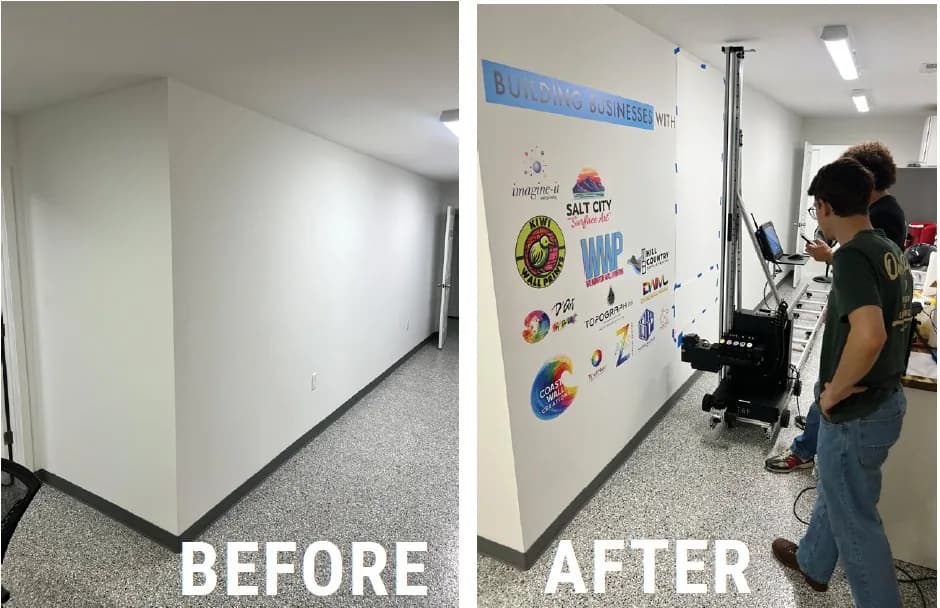
Office wall before and after a direct to surface printBefore / after
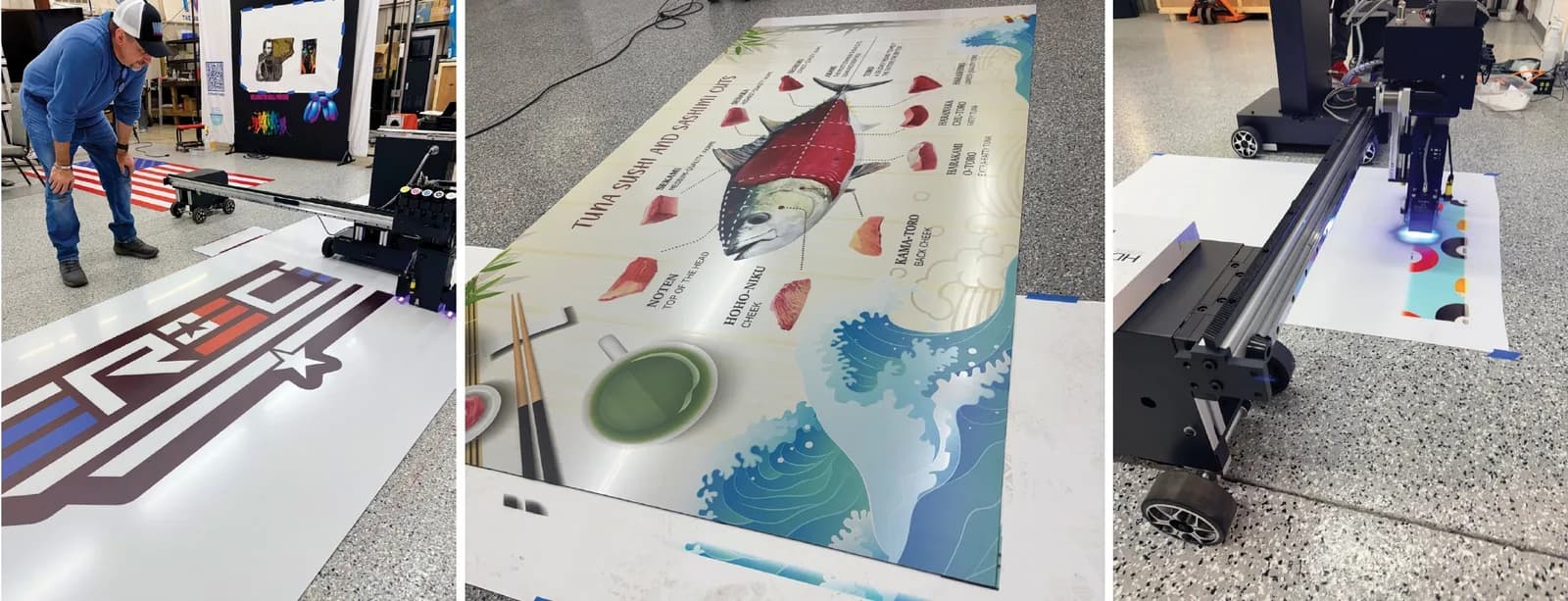
Three floor graphics printed by the FUV floor systemFloors
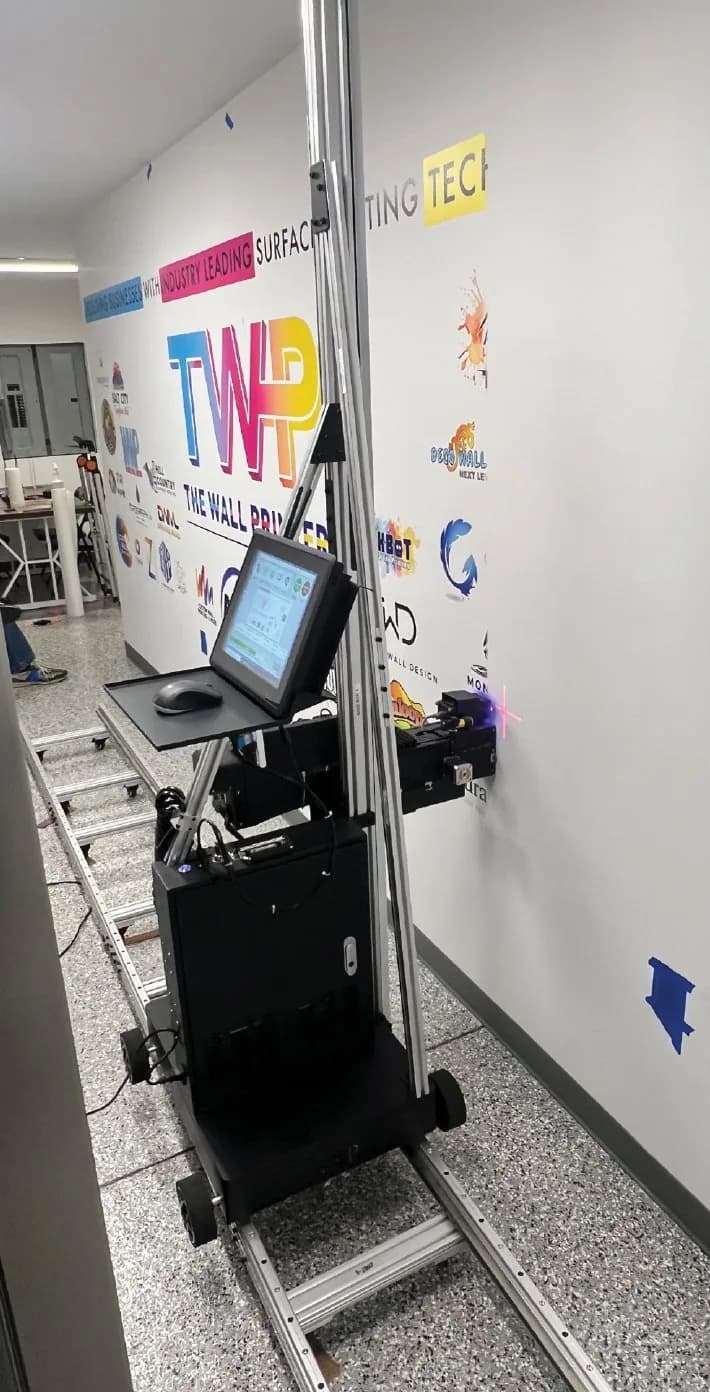
WP-UV-PRO machine printing in the Wilmington showroomThe machine
Why in house

Signage stops being a vendor and becomes a capability.

An outside signage cycle means quotes, lead times, installers on site, and vinyl that starts failing the day it goes up. An internal program means the request becomes a file, the file becomes a wall the same week, and the result is permanent. Three things make it work at scale.

Standardization

The quality lives in the file. A wayfinding system designed once prints identically in every building, on every shift, regardless of who runs the machine.

Speed

Setup runs 10 to 15 minutes on site, under 30 for full assembly, two people. No drying window, no closure, no waiting on an installer's calendar. A rebrand that used to rope off an aisle for a week happens overnight, in place.

Cost control

Ink is about fifty cents a square foot, and the machine is a one-time purchase with no per-print licensing and no software fee. Compare that against your annual outside graphics spend, building by building.

Two ways to run it

Own the fleet, or have the work delivered.

Bring it in house

Buy the machines, and we train your people in Wilmington on your own equipment, with the engineers who build it. Two and three machine fleet packages are priced lower per unit. Ask and we will put the number in writing. A 50 percent deposit starts the build. Delivery runs four to six weeks. Support is lifetime, nine to eight Eastern, seven days, from 2157 Dexter St, Wilmington NC 28403.

Hire the network

More than 300 independent businesses run our machines across the Americas. For a single building or a season of venue work, we will connect you with an operator near you, and you get the same end product with no equipment on your books. Six of them publish their phone numbers on the home page.

Not sure which fits? Text us the buildings and the problem and we will price it both ways. The machines themselves, and everything in the crate, are on the pricing page, with the per-job math on the cost page.

Model your current spend

Not what you would earn. What you would stop spending.

The worked example below is a portfolio of 20 locations producing 6,000 square feet a year, currently outsourced at a blended $16 a square foot. Every assumption is printed, and below roughly $60,000 a year in current spend the honest answer is to keep outsourcing, which the tool will tell you.

Current annual outsourced spend$96,000
Projected in house annual cost$26,400
Annual avoided cost thereafter$69,600
Year one net, equipment included$24,605
Payback8 months
Five year cumulative$303,005

In house cost in the example: ink at fifty cents a square foot, 80 operator hours per 1,000 square feet at $30 fully loaded, design at $6,000 and travel at $3,000 a year, equipment at $44,995. Now put your own numbers in:

Current annual spend on the displaced method$96,000
Projected in house annual cost$26,400 (ink $3,000, labor $14,400 at 480 hours, plus design and travel)
Cost per square foot, side by side$16.00 current vs $4.40 in house, before equipment
Year one net, equipment included$24,605
Annual net thereafter$69,600
Payback8 months
Five year cumulative difference$303,005

Assumptions printed: ink at fifty cents a square foot, 80 operator hours per 1,000 square feet including setup, travel and file prep, and your own numbers for rate, design and travel. The vinyl default rate is $15 a square foot published supplier material pricing plus install labor; every other method wants the rate from your own invoices. No hidden multipliers. Illustrative, not a quote.

The capital case, written down

Answers for the meeting where this gets decided.

How to get a wall printer approved

The capital request assembled the way finance wants it, the four questions you will get, and where this request should fail.

Who runs it, when nobody was hired to

Which existing role operates it, how many hours it takes, and the failure mode that puts machines under a tarp.

What an in house team actually prints in year one

The real volume inventory by facility type, and the minimum spend that justifies buying at all.

Running more than one machine

Centralized versus regional, the coordination role, and the three patterns that kill fleet programs in year two.

What a venue already spends on graphics

Five budgets, five vendors, no line that says graphics. The vinyl comparison with the assumptions showing.

Same file, four printers, four brand blues

Why color drifts across regional vendors, and why franchise compliance fails when the franchisee pays.

Questions

Asked the way operations teams ask them.

Can a company buy machines purely for internal use?

Yes, and it is a growing share of what we do. One of the world's largest e-commerce and logistics operators bought 6 units for internal wayfinding and compliance signage across its buildings. Your team owns the machines, your people run them, and the graphics program becomes an internal capability instead of a vendor relationship.

Who runs the machine, and how hard is it to learn?

Your own staff, after training with the team that engineers the machines. Setup on site takes ten to fifteen minutes, the machine moves in three cases that fit in an SUV, and the quality lives in the print file rather than in the operator's hands, which is what makes results repeatable across shifts and sites.

Is the ink safe for occupied buildings?

The ink is VOC free and UV cured, so it is dry the moment it is printed. No adhesive, no off-gassing, no drying window. Facilities run the work overnight or during operating hours without closing the space.

How durable is the result?

Indoors, 10 years and more indoors without noticeable fade. Outdoors, uncoated work holds two to three years and a protective clear coat extends it. There is no vinyl edge to lift and no laminate to fail, because the ink is in the surface, not on it.

What does an internal program cost to stand up?

Machines run $39,995 to $44,995 complete, with training, starter ink, cases and warranty, and certified reconditioned units start at $29,995. Ink runs about fifty cents a square foot. Two and three machine fleet packages are priced lower per unit, in writing, on request.

What if we want the walls without owning a machine?

Our owner network delivers finished work across North and South America. Tell us the buildings and the problem, and we will connect you with an operator, or price it both ways so you can compare delivery against bringing it in house.

Talk to us

Walk us through your building.

Text us what you are trying to fix and how many sites it touches. A real person in Wilmington answers, and if the honest answer is that vinyl or paint serves you better, you will get that answer.

Text us at 910-679-0962

Text "Get Started" and tell us your city. A real person answers, usually the same business day. Prefer to talk? Call 910.632.0320. North and South America.